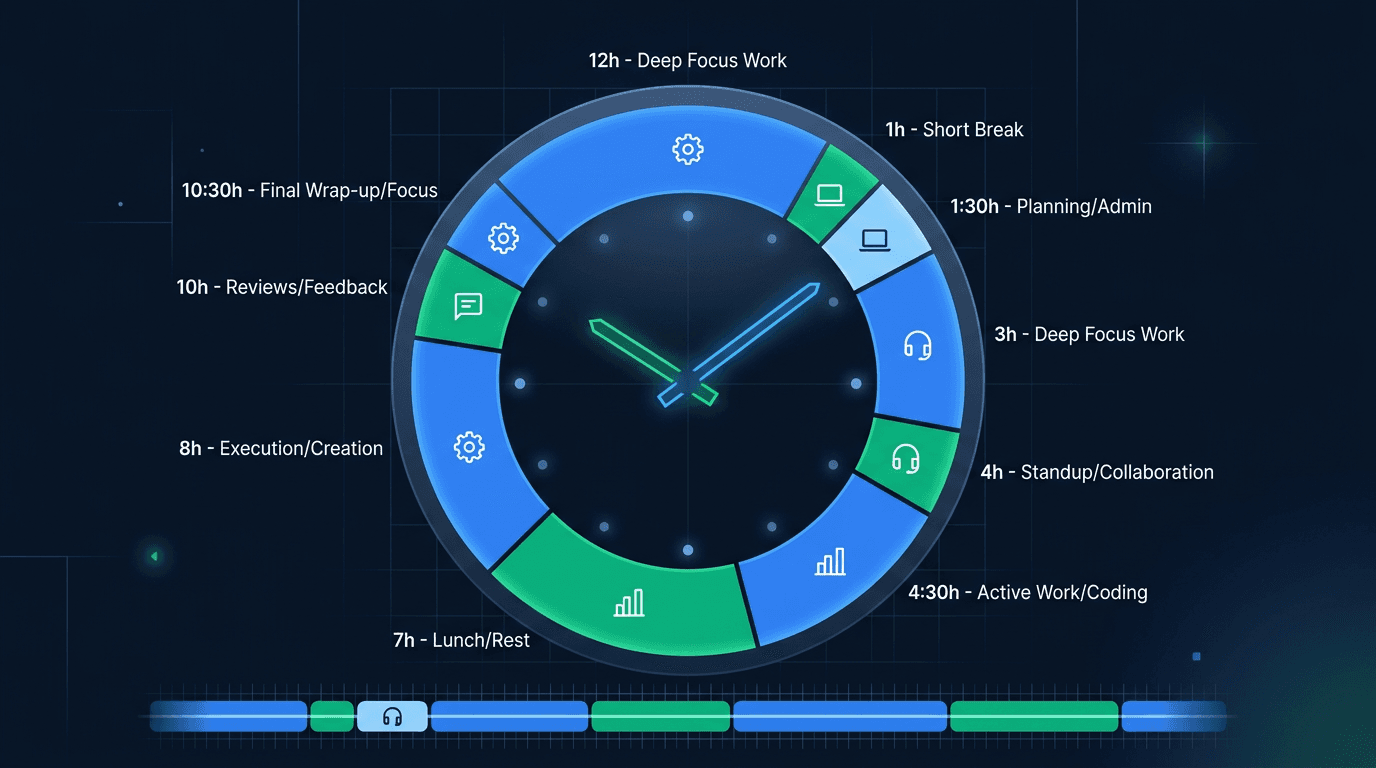
The difference between a $50,000/year insurance agent and a $200,000/year producer is rarely talent — it is how they structure their insurance agent daily schedule. According to a 2025 survey by the National Association of Insurance and Financial Advisors (NAIFA), top-quartile producers spend 65% of their working hours in revenue-generating activities (calling, presenting, closing), while bottom-quartile agents spend only 30%. This guide shows you exactly how to structure your day like a top producer.
Why Your Daily Schedule Determines Your Income
Insurance sales is fundamentally a numbers game with a time constraint. You have a limited number of productive hours each day, and how you allocate them directly determines your results.
- The math: If you make 150 dials per day, connect with 30 prospects, set 5 appointments, and close 25% — that is 1.25 policies per day, or roughly 25 per month. At $500 average commission, that is $12,500/month.
- Cut your dials in half because of poor time management, and your income drops proportionally to $6,250/month.
- Every hour spent on non-selling activities during prime calling hours costs you approximately $50-$100 in lost production.
The agents who consistently earn $150,000+ treat their schedule like a surgeon treats an operating room calendar — every minute has a purpose, and the highest-value activities get the best time slots.
Hour-by-Hour Schedule for Top Producers
Here is the daily schedule used by agents who consistently produce 20+ policies per month. Adjust the specific hours for your time zone and vertical, but protect the structure:
| Time | Activity | Duration | Purpose |
|---|---|---|---|
| 7:30 - 8:00 AM | Pre-game prep | 30 min | Review leads, check CRM, set daily goals |
| 8:00 - 8:15 AM | Hot lead follow-ups | 15 min | Call-backs from yesterday's requests |
| 8:15 - 10:00 AM | Morning calling block #1 | 105 min | Fresh leads and scheduled callbacks |
| 10:00 - 10:15 AM | Break | 15 min | Mental reset, hydrate, stretch |
| 10:15 - 12:00 PM | Morning calling block #2 | 105 min | Aged leads and prospecting calls |
| 12:00 - 1:00 PM | Lunch + Admin | 60 min | Eat, submit apps, update CRM notes |
| 1:00 - 3:00 PM | Afternoon calling block | 120 min | Peak contact hours for many demographics |
| 3:00 - 3:15 PM | Break | 15 min | Recharge before final push |
| 3:15 - 5:00 PM | Evening calling block | 105 min | Working professionals answer after 3 PM |
| 5:00 - 5:30 PM | End-of-day wrap | 30 min | Log activities, plan tomorrow, submit apps |
This schedule dedicates 7+ hours to calling and only 90 minutes to admin and breaks. That ratio is the key differentiator between top and average producers.
The Calling Block Strategy
Calling blocks are uninterrupted periods dedicated exclusively to outbound dialing. No email, no CRM cleanup, no paperwork — just dial after dial. Here is why they work:
- Momentum builds with volume. Your first 10 calls of the day feel awkward. By call 30, you are in a rhythm. By call 50, you are sharp. Interruptions reset this momentum.
- Context-switching costs 23 minutes. Research from the University of California, Irvine shows it takes an average of 23 minutes to fully refocus after an interruption. Three interruptions per calling block could cost you over an hour of productive time.
- Prospects sense confidence. When you are in flow, your tone is more natural, your objection handling is sharper, and you close more effectively.
Rules for Effective Calling Blocks
- Close your email client and silence your phone notifications
- Set a specific dial count goal for each block (e.g., 50 dials per 90-minute block)
- Use a power dialer to eliminate manual dialing between calls
- Keep water and your script/objection sheets within arm's reach
- Do not stop to submit applications mid-block — note the details and submit during admin time
Prime Calling Hours by Insurance Vertical
Not all prospects answer at the same time. Optimize your calling blocks based on your target market:
| Vertical | Best Morning Window | Best Afternoon Window | Notes |
|---|---|---|---|
| Medicare (65+) | 9:00 - 11:30 AM | 1:00 - 3:00 PM | Seniors are home and alert mid-morning |
| Final Expense | 9:00 - 11:00 AM | 2:00 - 4:00 PM | Similar to Medicare, slightly younger demographic |
| Life Insurance (30-55) | 8:00 - 9:00 AM | 4:00 - 6:30 PM | Working adults: catch before/after work |
| ACA Health | 10:00 - 12:00 PM | 3:00 - 5:30 PM | Mix of self-employed and unemployed |
| Auto/Home | 9:00 - 11:00 AM | 5:00 - 7:00 PM | Evening hours produce highest contact rates |
For tips on converting the leads you reach during these windows, read our guide on how to convert insurance leads.
Admin Time: When and How Much
Administrative tasks are necessary but should never consume your prime selling hours. Top producers follow the 30/70 rule: no more than 30% of your day on admin, at least 70% on revenue-generating activities.
- Application submission: Batch these during lunch or end-of-day. Do not stop a calling block to submit an app unless there is a same-day deadline.
- CRM updates: Use shorthand notes during calls, then clean them up during admin blocks. Better yet, use voice-to-text CRM entry.
- Email: Check twice per day — once at the start and once after your last calling block. Constant email checking is a productivity killer.
- Continuing education: Schedule CE courses for evenings or weekends. Never sacrifice calling hours for compliance training that can happen off-peak.
- Marketing and social media: Batch content creation on Sunday evenings. Schedule posts for the week using Buffer or Hootsuite.
Prospecting and Lead Follow-Up Blocks
Dedicated prospecting time ensures your pipeline stays full even when current leads are flowing. Allocate at least 30-60 minutes daily to these activities:
- Referral requests: Call 3-5 existing clients per day and ask for referrals. This takes 15 minutes and is the highest-ROI prospecting activity.
- Social selling: Spend 15 minutes engaging with prospects on LinkedIn or Facebook — commenting on posts, sharing helpful content, responding to questions in insurance groups.
- Community networking: Schedule 1-2 in-person events per week (chamber of commerce, senior centers, realtor meetups) during non-peak calling hours.
- Long-term follow-ups: Revisit leads from 30-90 days ago who showed interest but did not close. A quick check-in call often catches prospects whose circumstances have changed.
Learn more about sustainable prospecting in our 2026 lead generation guide.
Work-Life Balance for Insurance Agents
Burnout is the leading cause of agent attrition, with SHRM research showing that 44% of sales professionals report feeling burned out. Sustainable production requires boundaries:
- Set hard start and stop times. Working 8 AM to 6 PM five days a week (50 hours) is more sustainable and productive than erratic 12-hour days.
- Protect one full day off per week. No calls, no emails, no CRM. Your brain needs time to reset.
- Take real vacations. Top producers report taking 2-3 weeks off per year without significant income drops because their pipeline and renewal income sustain them.
- Exercise in the morning. A 30-minute workout before your pre-game prep improves energy, focus, and mood for the entire day.
- Batch personal errands. Handle appointments, errands, and household tasks on one designated afternoon rather than scattering them throughout the week.
Remote vs. Office Schedule Differences
Remote insurance agents face unique scheduling challenges. Without an office environment, distractions multiply. Here are adjustments for remote producers:
- Create a dedicated workspace. A separate room with a closed door signals to your brain (and family) that you are working.
- Use time-blocking apps. Tools like Clockify or Toggl track how you actually spend your time versus how you think you spend it. Most agents are shocked by the data.
- Start calling 15 minutes earlier than office-based agents. The commute time you saved is free production time.
- Schedule virtual co-working sessions. Some remote teams use Zoom rooms where agents dial together in real-time, recreating the energy of a bullpen environment.
Weekly Planning and Review Rituals
The best daily schedules are built on weekly planning. Dedicate 30 minutes every Sunday evening or Monday morning to:
- Review last week's numbers: Dials, contacts, appointments, closes, and revenue. Know your conversion rates cold.
- Set this week's goals: Specific, measurable targets for each metric. "Close 5 policies" is better than "have a good week."
- Pre-load your dialer: Upload fresh leads, set callback reminders, and organize your calling lists by priority.
- Block appointments and meetings: Schedule any non-calling activities (carrier meetings, CE courses, team calls) outside of prime calling windows.
- Identify one skill to improve: Pick one area to focus on — objection handling, closing language, product knowledge — and practice it daily.
Frequently Asked Questions
How many hours should an insurance agent work per day?
Most top producers work 8-10 hours per day, with 5-7 of those hours spent on the phone. The key is not total hours worked but hours spent in revenue-generating activities. A focused 8-hour day with 6 hours of calling outproduces a scattered 12-hour day with 3 hours of calling.
What time should insurance agents start calling?
It depends on your target market. For Medicare and final expense (seniors), 9:00 AM is ideal. For life insurance and ACA health (working adults), you can start as early as 8:00 AM or focus on evening hours (4:00-7:00 PM) for the best contact rates.
How do I avoid burnout as an insurance agent?
Set hard boundaries on work hours, take at least one full day off per week, exercise regularly, and build a pipeline large enough that missing one day does not create financial stress. Agents with strong renewal books experience far less burnout because their income is not 100% dependent on daily activity.
Should I work weekends as an insurance agent?
Working a half-day on Saturday (9 AM - 1 PM) can be productive for reaching prospects who are unavailable during the week. However, working every weekend leads to burnout. Consider alternating: one Saturday on, one Saturday off. Never work Sundays unless you are in a seasonal crunch like AEP.
Structure your day for maximum production, then fuel it with leads that convert. Contact InsureLeads to build a lead delivery schedule that matches your peak calling hours and production goals.